

 Español
 عربى
عربى русский
Walk into any modern commercial kitchen, hospital ward, or pharmaceutical cleanroom. Look at the walls. They're not painted drywall. They're not ceramic tile. They're not stainless steel. What you're seeing is likely a stone-plastic composite panel—rigid, waterproof, impact-resistant. And behind every shipment of those panels stands an SPC panel factory, the place where raw powders and films become building materials that outperform traditional wall coverings in almany every measurable way.
Why Traditional Wall Materials Fall Short
Drywall is a moisture magnet
It absorbs humidity, swells at the edges, and feeds mold behind the surface. One leak, one steam pipe, one high-humidity summer—and the wall starts crumbling from the inside out.
Tile and grout are maintenance traps
Grout lines stain, crack, and collect bacteria. Regrouting is expensive. Deep-cleaning requires harsh acids that etch the tile surface over time. And dropped tools or cart impacts chip the ceramic, leaving permanent eyesores.
Stainless steel looks industrial and shows everything
Fingerprints, water spots, and scuffs are visible from across the room. It dents easily under impact. And the material cost—plus specialized welding for seams—puts it out of reach for many budget-conscious projects.
An SPC panel factory addresses each of these failures with a single product. The panel doesn't absorb water—so no swelling, no mold food. The surface is seamless and non-porous—so no grout lines for bacteria to hide in. The core is rigid but slightly resilient—so carts and gurneys bounce off rather than leaving permanent dents. And the color and pattern are baked into the construction, not painted on top—so they don't fade, scratch through, or need refreshing.
The Making of a Panel Nobody Thinks About
Mixing the right recipe for each application
Limestone powder, PVC resin, and stabilizers go into high-speed mixers. The proportions shift depending on the final use—more limestone for big rigidity in high-impact corridors, more resin for slight flexibility in curved installations. An SPC panel factory runs multiple recipes simultaneously, switching between formulations for wall panels, ceiling tiles, and cold-storage cladding.
Extruding and calendering to exact thickness
The blended compound is heated, melted, and forced through a flat die. It emerges as a continuous sheet, still hot and pliable. Rollers compress it to the target thickness—typically 3 to 10 millimeters—while cooling it in staged zones. An SPC panel factory monitors temperature, pressure, and line speed at dozens of checkpoints. Cool too fast and the panel warps. Cool too slow and production backs up. The sweet spot varies by recipe and season.
Laminating the decorative face and protective layer
Above the core goes a high-resolution printed film—wood, stone, fabric, or solid color. Above that, a clear wear layer is fused under heat and pressure. An SPC panel factory offers this wear layer in different grades:
- Standard for general office walls and ceilings;
- Heavy-duty for kitchens, labs, and high-traffic corridors;
- Chemical-resistant for pharmaceutical and food-processing environments.
Adding backing and finishing edges
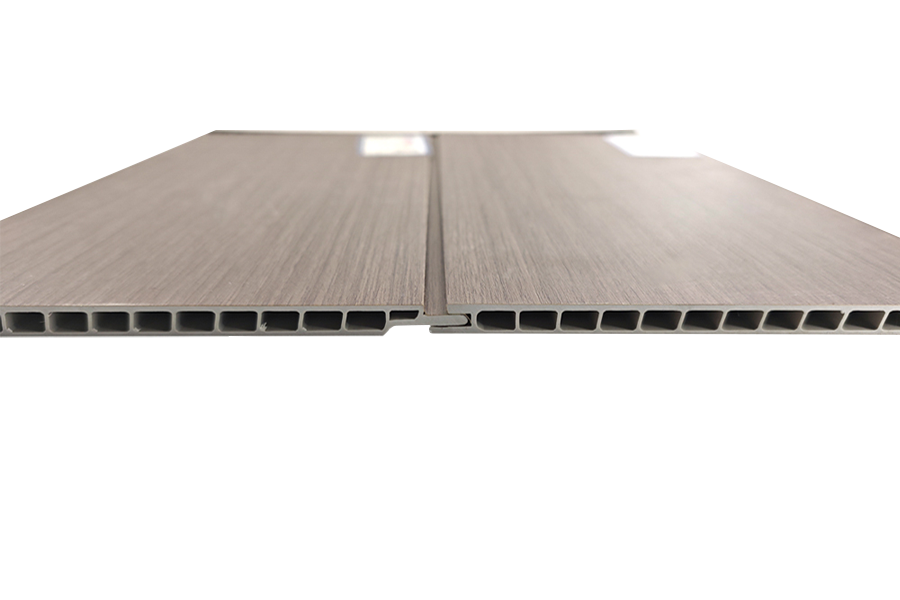
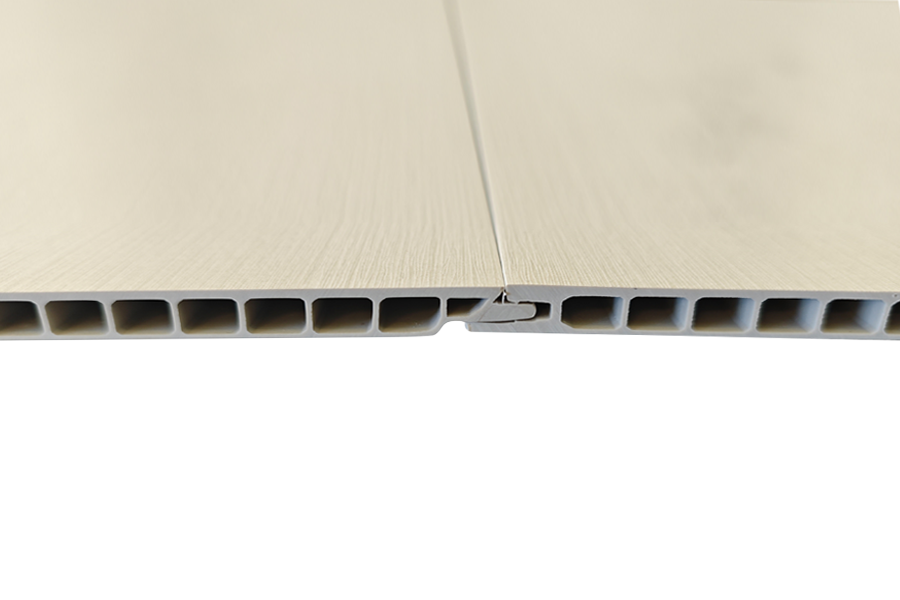
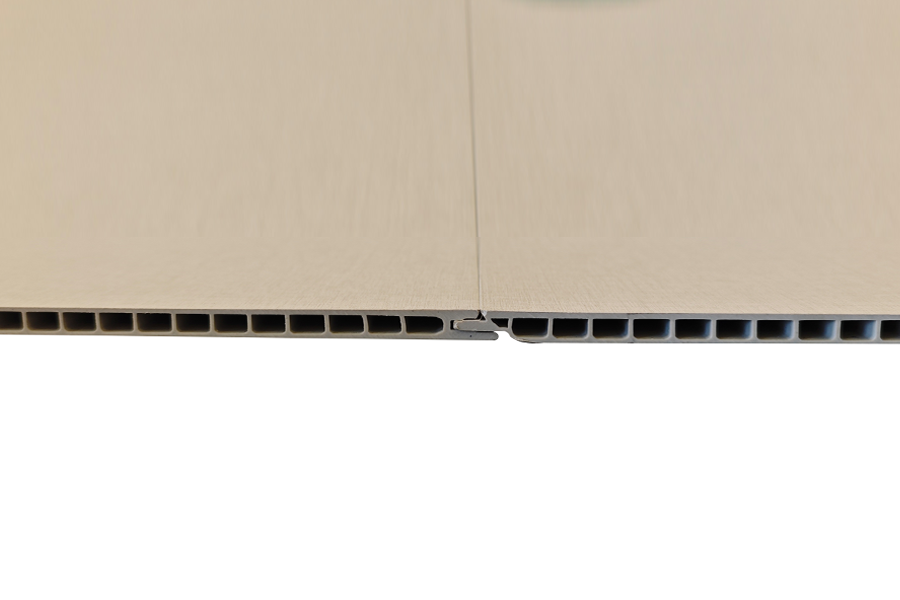
Some applications need thermal insulation or sound absorption. An SPC panel factory applies a closed-cell foam backing in those cases. Others need flush, gap-free seams—so the factory mills tongue-and-groove profiles into the long edges. For exposed joints, straight-cut edges with matching trim strips are provided instead.
Cutting, stacking, and shipping
The continuous sheet is trimmed to standard sizes—4x8 feet, 4x10 feet, or custom dimensions per order. Each panel is inspected for thickness uniformity, surface defects, and edge straightness. Stacked, strapped, and palletized, they leave the factory floor within 48 hours of production.
The Unseen Differences Between Factories
Raw material sourcing affects every property
An SPC panel factory that buys consistent-grade limestone and virgin PVC produces panels with predictable density, color, and bonding strength. A factory that cuts corners with off-spec resin or contaminated filler delivers panels that warp, bubble, or delaminate within the first year. The difference shows up in peel tests, impact ratings, and long-term field performance.
Process control separates reliable from risky
Thickness tolerance, density variation, and cooling ramp rates are the hidden variables. An SPC panel factory with in-line scanning catches drift before it becomes rejects. Factories without real-time monitoring ship the problems to customers—who discover them during installation when panels don't line up, don't lock, or don't stay flat.
Edge milling determines installation success
Tongue-and-groove edges must be milled clean and square. An SPC panel factory uses diamond-tipped cutters replaced on strict schedules. Ragged edges cause:
- Gaps that collect dirt and moisture;
- Wavy seams that ruin the visual effect;
- Joint failure under thermal expansion or building settling.
Testing and documentation build trust
A serious factory provides data—not just promises. An SPC panel factory shares flammability test results, chemical resistance panels, and peel-strength records. It publishes VOC emission reports. It lists warranty terms that match the application—15 years for residential, 5 to 10 years for heavy commercial.
Where You'll Find These Panels Without Realizing It
That walk-in cooler at the grocery store
The walls are SPC. They handle -10°C continuously without becoming brittle. They're hosed down nightly with sanitizer. No rust, no rot, no recurring maintenance. The panels have been there for seven years and still look new.
The surgery prep area at the local hospital
SPC again—but with antimicrobial additives in the surface layer. The panels are wiped with glutaraldehyde and peracetic acid multiple times a day. The surface stays glossy and intact. Joints are sealed with chemical-resistant caulk, leaving no crevices for biofilm formation.
The school corridor where backpacks and carts hit every wall
SPC panels take the abuse. Kids lean against them, rolling carts scrape along them, janitorial machines bump into them. The wear layer absorbs the scratches. The core absorbs the impacts. The wall still looks presentable after five years of constant use.
The cleanroom where particle count matters
SPC panels with low-outgassing formulation are installed with seamless joints and radius corners. The surface is static-dissipative—dust doesn't cling. The panels don't shed fibers or particles, and they withstand daily wipedowns with isopropyl alcohol.
The restaurant dining area where aesthetics count
Wood-look SPC panels cover the feature wall. They look like reclaimed barnwood but clean up with a damp cloth. No sealing, no staining, no worrying about grease splatter from the nearby open kitchen. The owner picked them specifically because they look expensive but aren't.
An SPC panel factory isn't just making sheets of plastic composite. It's solving problems that architects, facility managers, and contractors have lived with for decades—moisture damage, impact scars, cleaning fatigue, and short replacement cycles. The good factories do it with consistent materials, tight process control, and transparent testing. The others cut corners and hope nobody notices. Choose carefully, because the panel on the wall today will still be there ten years from now—either as a point of pride or as an expensive mistake to tear out.