

 Español
 عربى
عربى русский
Types of SPC Soffit Panels
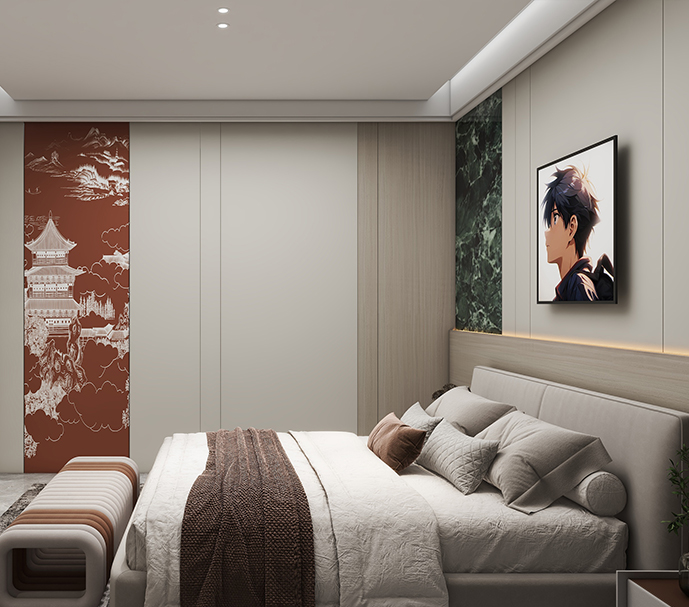
SPC soffit panels are rigid, weather-resistant panels used for the underside of roof overhangs (eaves), porches, and carports. SPC is a composite of calcium carbonate (limestone powder, 60–70%), polyvinyl chloride (PVC, 20–30%), and plasticizers/stabilizers (5–10%). Unlike traditional vinyl or wood soffit, SPC does not warp in heat (up to 60°C) and does not absorb moisture. It is heavier (2.5–4.5 kg per square meter) and more dent-resistant. The following types are distinguished by surface texture, venting, and edge profile.
Solid SPC soffit panel (non-vented). A flat, continuous panel with no holes. Used where attic ventilation is provided by other means (ridge vents, gable vents). The surface can be smooth (glossy finish, shows scratches) or wood-grain embossed (textured, hides minor damage). Thickness: 4–6 mm. Panel width: 300–600 mm, length: 2–3 meters. Color options: white, beige, gray, black, and wood tones (oak, walnut). Solid panels have the highest wind resistance (no perforations). They are used in hurricane-prone regions (Florida, Gulf Coast) because solid panels do not allow wind-driven rain to enter the soffit.
Vented SPC soffit panel (perforated). Has rows of small holes (2–5 mm diameter) or continuous slots (1–2 mm wide) that allow air to flow into the attic. Venting area is typically 30–50 cm² per linear meter (some codes require 1:300 ratio of vent area to attic floor area). The holes are spaced 15–30 mm apart. Vented panels are used with ridge vents to create a continuous airflow (air enters through soffit, exits at the ridge). Dust and insects can pass through the holes; some vented panels include a mesh screen (nylon or aluminum, 0.5–1 mm mesh) glued to the back. The mesh reduces airflow by 20–30% but keeps out wasps and mud daubers. Vented SPC panels are less common than vented aluminum soffit because SPC vents must be drilled, which can create stress risers (cracks).
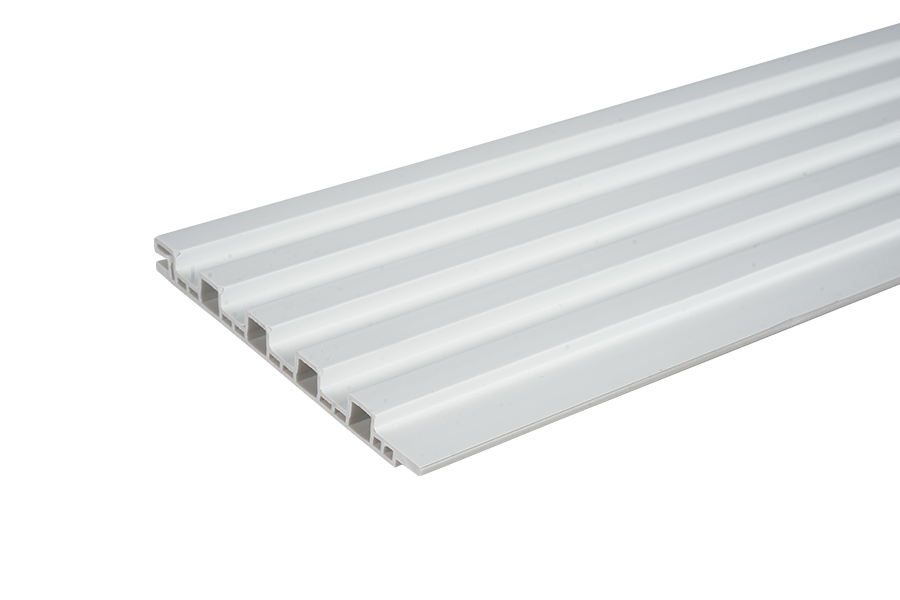
Grooved (shadow line) SPC soffit. The panel surface has linear grooves (V-shaped or U-shaped, 3–6 mm deep) that mimic the look of individual wood planks. The grooves run parallel to the length of the panel. Between grooves, the panel is flat (30–50 mm wide strips). This is purely decorative; it does not affect ventilation or strength. Grooved panels are more expensive (additional milling step). They hide minor warping or uneven house framing (the shadow lines break up the visual field). Non-grooved (flat) panels show every imperfection in the substrate.
SPC Soffit Panel Material Information
Core composition – stone powder and PVC resin. SPC is not a single material but a blend. The "stone" is calcium carbonate (CaCO₃), ground limestone to a particle size of 5–20 µm. Calcium carbonate content is 60–70% by weight. This provides rigidity (flexural modulus 4,000–6,000 MPa, similar to medium-density fiberboard). The "plastic" is PVC (polyvinyl chloride) resin (K-value 60–65), comprising 20–30% of the weight. PVC acts as a binder. The two are mixed with 5–10% of additives: stabilizers (calcium-zinc or organotin, 1–2%) to prevent thermal degradation during extrusion; plasticizers (DOTP or DINP, 2–5%) to provide flexibility (prevent cracking during flexing); lubricants (wax or stearic acid, 0.5–1%) to aid extrusion; and pigments (TiO₂ for white, 5–8%; or carbon black for dark colors, 1–2%). The mixture is heated to 180–200°C and extruded into a flat die, then cooled under pressure (calendered) to set the shape. The resulting panel is dense (specific gravity 1.5–2.0, vs. 0.9–1.0 for vinyl). Water absorption is below 0.1% (by ASTM D570).
Surface texture and UV resistance. The surface can be smooth (glossy, 60-degree gloss meter reading 40–70) or embossed (wood grain, 5–15 gloss). The embossing is applied by a textured steel roller during calendering. The depth of embossing is 0.1–0.3 mm. The surface is not painted; the color is integral (through the entire thickness). For UV protection, TiO₂ is the most effective white pigment; it absorbs UV light (290–380 nm) and converts it to heat. Without TiO₂, the PVC degrades by dehydrochlorination (loss of HCl), turning yellow and then brown. The rate of yellowing: in Miami, Florida (annual UV exposure 220 MJ/m²), a panel without UV stabilizers yellows visually (ΔE > 3) in 6–9 months. A panel with 8% TiO₂ lasts 10–15 years before noticeable color change. For dark colors (black, dark brown), the pigment itself blocks UV (carbon black is an excellent UV absorber). Dark panels may fade (become lighter) over 5–7 years because the pigment degrades.
Dimensional stability and thermal expansion. SPC has a coefficient of linear thermal expansion (CLTE) of 0.04–0.07 mm/m·°C (40–70 × 10⁻⁶ /K). This is much lower than vinyl (0.10–0.15) and similar to aluminum (0.023). For a 3-meter panel, a temperature change from -10°C (winter installation) to 60°C (summer exposure) is 70°C. Expansion = 3.0 m × 0.07 mm/m·°C × 70°C = 14.7 mm. Without expansion gaps, the panels will buckle (push against each other, creating a wave). Therefore, installation requires a 5–10 mm gap at each end, covered by a J-channel or H-trim. If the panel is constrained (screwed down tightly), it cannot expand; it will bow outward (up to 20 mm over 1 meter) or the screw holes will tear. The low CLTE of SPC is still higher than the house structure (wood framing expands 0.005 mm/m·°C along the grain, so wood expansion is negligible). So you cannot attach the panels rigidly at both ends.